
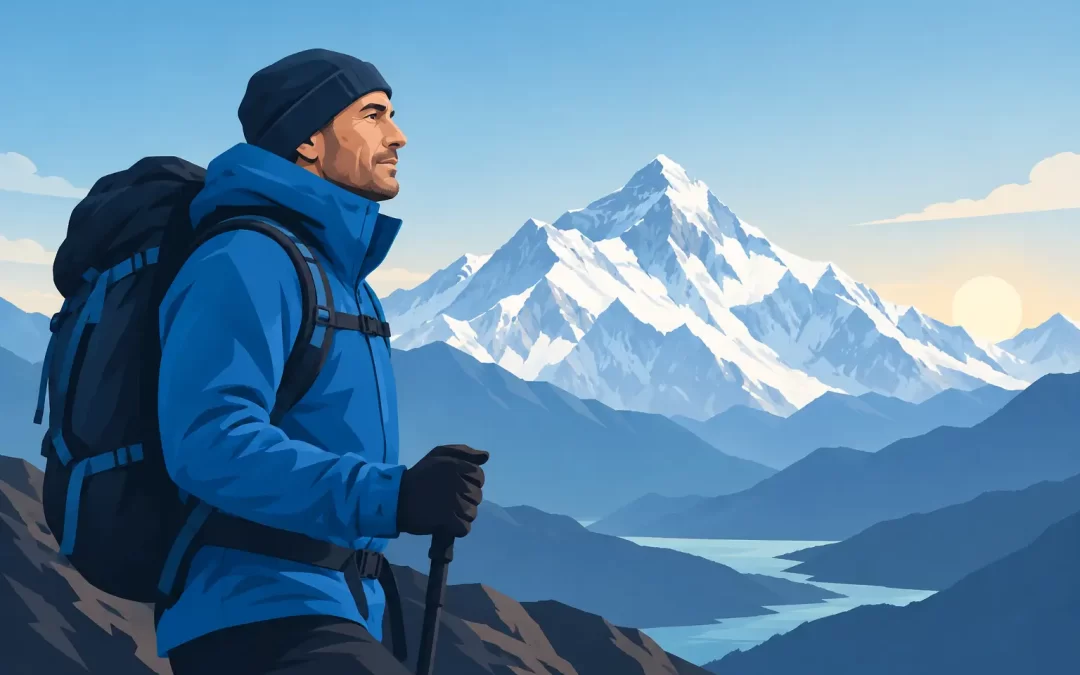
A mountain does not care about a title, a job description, or how confident a team felt in the hotel ballroom the night before. At altitude, the margin for error narrows, conditions change without permission, and every person must decide what to do next. Gary Guller’s survival story begins long before Everest, but it carries this same truth: adversity does not ask whether you are ready. It asks who you will become when the plan is no longer enough.
For leaders, event planners, and organizations facing relentless performance pressure, that distinction matters. A powerful story is not simply one that describes hardship. It is one that shows people how hardship can be met with courage, preparation, accountability, and a belief that no one reaches the top alone.
Gary Guller’s Survival Story Started With a Choice
Gary Guller lost his left arm in a train accident as a young man. The physical loss was immediate. The larger challenge came afterward, in the questions that can quietly reshape a life: What is still possible? What is the new definition of strength? How do you move forward when the future you expected is suddenly gone?
There is no shortcut through that kind of change. Survival is not a single triumphant moment. It is a series of choices made when motivation is low, confidence is shaken, and progress is difficult to measure. For Gary, those choices led toward endurance sports, high-altitude climbing, and a life built around confronting limits rather than accepting them as permanent.
That is why this story resonates beyond the mountains. Organizations often talk about resilience as if it is a personality trait that some people naturally possess. In reality, resilience is practiced. It grows when people face a setback honestly, adjust the strategy, ask for help, and take the next useful step.
Everest Was Never a Solo Achievement
In 2003, Gary became the first person with one arm to summit Mount Everest. The achievement stands on its own, but the lesson is bigger than the record. Everest is often presented as a symbol of individual willpower. The reality is more demanding and more useful for teams: climbing safely requires an extraordinary degree of coordination.
Every decision on an expedition has consequences. Equipment must be checked. Communication must be clear. Weather must be respected. Team members must recognize when someone is struggling, speak up early, and make decisions based on shared priorities rather than ego. A summit is meaningful, but getting everyone home is the standard that matters.
Corporate teams face a different terrain, yet the underlying challenge is familiar. A sales kickoff can create energy, but execution requires daily discipline. A strategic plan may be clear in the boardroom, but it can fail when departments work from conflicting assumptions. A transformation initiative may have executive sponsorship, yet stall if people do not feel safe raising concerns.
The strongest teams do not wait for perfect conditions. They prepare thoroughly, communicate constantly, and remain flexible when conditions shift. They understand that ambition without alignment becomes risk. They also understand that a teammate’s request for support is not weakness. It is an opportunity to protect the entire mission.
The difference between pressure and purpose
High performers are often praised for carrying more. But carrying more is not always the same as leading well. On Everest, a climber who ignores exhaustion can endanger the team. In business, a leader who hides a problem, refuses to delegate, or confuses urgency with clarity can create the same kind of exposure.
Purpose gives pressure a direction. It reminds people why the work matters and what success must include. That might mean protecting customer trust while accelerating growth. It might mean hitting a demanding revenue target without sacrificing the culture that makes performance sustainable. It might mean ensuring that every voice can contribute when a team is solving a complex problem.
Gary’s experience challenges the familiar myth of the heroic lone performer. The point is not to prove that one person can do everything alone. The point is to show what becomes possible when individual determination meets a committed team.
Turning Setbacks Into High-Performance Practice
A survival story becomes useful when it changes behavior. The practical value of Gary Guller’s journey is not that every audience member should climb a mountain. It is that every audience member can identify the mountain in front of them: a difficult quarter, a major reorganization, a strained relationship, a personal setback, or a goal that feels beyond reach.
The first discipline is to name reality clearly. Teams lose momentum when they minimize obstacles or use optimism to avoid difficult conversations. Acknowledging the challenge is not pessimism. It is the starting point for sound judgment.
The second discipline is preparation. On a mountain, preparation includes training, equipment, route planning, contingency decisions, and learning how to manage risk. In an organization, it means clarifying ownership, establishing decision rights, anticipating friction, and making sure people have the resources and information required to act.
The third is communication under pressure. When conditions are easy, almost any communication system can appear effective. The real test comes when priorities collide, time is limited, and people have incomplete information. Leaders earn trust when they communicate directly, listen with care, and create an environment where bad news travels quickly enough to be useful.
Finally, high performance requires a willingness to adapt. Persistence is essential, but persistence without awareness can become stubbornness. Sometimes the courageous decision is to continue. Sometimes it is to pause, change the route, or let go of an approach that no longer serves the mission. Knowing the difference is one of the clearest signs of mature leadership.
Inclusion Is a Performance Advantage
Gary’s Everest record and his leadership of a record-setting cross-disability Everest Base Camp expedition offer another vital lesson for modern organizations. Inclusion is not a charitable add-on to performance. It strengthens performance by expanding how teams see obstacles, solutions, and human potential.
Too often, people are evaluated according to a narrow picture of what capability looks like. That picture can cause leaders to overlook talent, underestimate colleagues, and build systems that work only for a select few. A more inclusive culture does not lower the standard. It raises the quality of the team by expecting excellence while recognizing that people may reach it in different ways.
For an executive team, that can mean inviting perspectives that challenge a familiar assumption. For a sales organization, it can mean designing a culture where people can ask for coaching before a number slips out of reach. For a university audience, it can mean seeing disability not as a final definition, but as one part of a person’s experience and contribution.
The business case is direct. Teams that make room for candor, difference, and shared problem-solving are better equipped to adapt when the environment changes. They see more options because more people are empowered to speak.
What Audiences Carry With Them
The lasting impact of a keynote is not applause in the moment. It is the conversation people have afterward, the decision a manager makes differently, and the standard a team chooses to uphold when no one is watching.
Gary Guller’s story brings the stakes of leadership into sharp focus because it is lived, not theoretical. Through the realities of loss, endurance, Everest, and team expeditions, audiences can see that limits are often more negotiable than they first appear. They can also see that courage is not the absence of fear. It is the decision to move with purpose despite it.
The next challenge may not look like Everest. It may arrive as a changing market, a demanding client, a difficult conversation, or a goal that stretches every member of the team. Meet it with clear eyes, bring the right people close, and take the next step together. That is how extraordinary progress begins.