
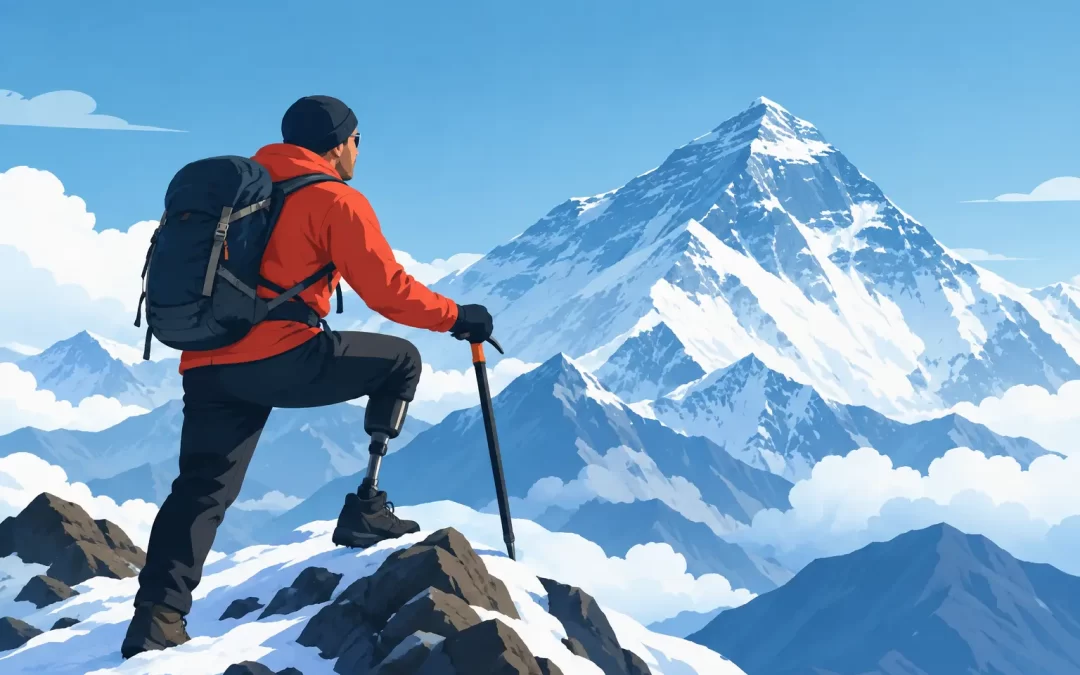
At 29,035 feet, a summit is never a solo achievement. Disability climber Gary Guller knows that truth in a way few people on earth can claim. As the first person with one arm to reach the summit of Mount Everest, he did not arrive there through willpower alone. He arrived through preparation, trust, communication, disciplined decision-making, and a team committed to moving through danger together.
That distinction matters for leaders who are tired of motivational stories that end at the applause line. Gary’s story is not simply about overcoming a physical limitation. It is about what happens when a person, a team, and a shared mission are tested beyond what feels reasonable. The mountain provides the proof. The business lessons come from the choices made before, during, and after the climb.
Disability Climber Gary Guller Redefined the Possible
Everest is an unforgiving place to test an idea. At extreme altitude, the body weakens, weather shifts without permission, and a small communication breakdown can become a serious consequence. Reaching the top demands more than individual toughness. It requires every climber to understand the mission, respect the conditions, and make decisions that protect the entire team.
Gary Guller’s Everest summit challenged a narrow assumption about who belongs in high-performance environments. His achievement did not ask others to lower the standard. It proved that standards can remain extraordinarily high when people rethink the path, prepare intelligently, and refuse to confuse a conventional method with the only possible method.
For organizations, that is a vital distinction. Inclusion is not a charitable gesture or a slogan placed on a slide. At its best, it is a performance advantage. Teams become stronger when people bring different perspectives to risk, problem-solving, communication, and execution. A culture that sees capability only through familiar credentials can miss exceptional talent. A culture that asks, “What will it take for this person to succeed?” creates more ways to win.
Gary’s journey also carries a more personal challenge. Most limits do not announce themselves as limits. They often show up as assumptions: I am not ready. Our team has always done it this way. The target is too aggressive. The change is too disruptive. Everest makes those assumptions visible because the stakes are so clear. In the workplace, they can remain hidden until performance stalls.
The Teamwork Behind an Everest Summit
The popular version of achievement focuses on the person holding the flag at the top. The real work happens much earlier, in the agreements and habits that make progress possible. On a mountain, climbers depend on one another for information, pace, safety, morale, and accountability. There is no room for vague expectations when conditions deteriorate.
Gary’s experience translates directly to teams facing ambitious growth goals, major transformations, complex sales cycles, or pressure-filled client commitments. High-performance teams do not merely share a destination. They establish how they will operate when the path gets steep.
That means communicating early rather than waiting for perfect information. It means giving direct feedback before a small issue becomes a costly one. It means recognizing when a teammate needs support and having the confidence to ask for help when your own capacity is stretched. These are not soft skills at altitude or in business. They are execution skills.
The cross-disability Everest Base Camp expedition Gary led made that lesson even more visible. A diverse group does not become a team simply by traveling under the same banner. Teamwork requires people to understand one another’s needs, strengths, pace, and contributions. The expedition’s record-setting accomplishment was built through intentional cooperation, not through pretending that every participant faced the same journey.
Corporate leaders can apply that principle without turning every challenge into a mountain metaphor. Ask whether the team has real clarity about roles. Ask whether people can raise concerns without being dismissed. Ask whether the strongest voices are creating space for quieter expertise. When a group is under pressure, inclusion and communication are not separate initiatives. They are the operating system.
Resilience Is Not Refusing to Feel the Weight
Resilience is often described as pushing through no matter what. That definition sounds impressive, but it can reward bad judgment. On Everest, refusing to adapt can be dangerous. Conditions change. Energy fades. Plans require adjustment. The strongest climber is not always the one who keeps moving fastest. Often, it is the one who recognizes reality, makes a disciplined decision, and preserves the capacity to continue.
Gary’s story offers a more useful view of resilience for executives and teams. Resilience is the ability to meet adversity honestly, recover deliberately, and keep acting in service of the mission. It includes courage, but it also includes humility.
That matters when a company misses a target, loses a major customer, faces a disruptive market shift, or asks a team to deliver through uncertainty. Leaders do their people no favors by offering empty certainty. They build trust by naming the challenge, setting the next priority, and showing the behaviors they expect from everyone in the room.
There is a trade-off here. Constant urgency can create short bursts of effort, but it eventually drains judgment and commitment. Sustainable high performance requires recovery, perspective, and a reason to continue. The best teams know when to press forward and when to reassess the route. Both choices can be acts of leadership.
From Expedition Story to Organizational Action
A powerful keynote should leave an audience energized, but energy alone fades. The value comes when a story gives people language for the challenges they already face. Gary’s live presentations use vivid expedition experiences, personal vulnerability, and multimedia moments to create that connection. The audience sees the scale of the challenge, then recognizes its own version of the climb.
For an event planner, that makes the topic especially useful when a gathering needs more than a polished presentation. A sales kickoff may need renewed belief after a demanding year. A leadership meeting may need a stronger conversation about accountability. An inclusion initiative may need a speaker who can connect the subject to achievement rather than treating it as an obligation. A university audience may need an example of ambition that feels both extraordinary and human.
The right emphasis depends on the organization. A team managing change may respond most strongly to Gary’s lessons on adaptability. A leadership group may focus on trust and communication. A company working to build a more inclusive culture may find the deepest value in the way his experience challenges assumptions about ability and contribution.
What remains consistent is the credibility of lived experience. Gary does not present resilience as a theory borrowed from a textbook. He brings audiences into an environment where preparation matters, excuses have consequences, and every person’s contribution can affect the outcome. That is why the story reaches beyond Everest.
A Better Question Than “Can We Do It?”
When a goal feels out of reach, teams often ask whether it can be done. It is a reasonable question, but it is rarely the most productive one. A better question is: What must we become, learn, communicate, and do differently to give ourselves a real chance?
That question shifts attention from limitation to responsibility. It does not deny obstacles. It respects them enough to prepare for them. It asks leaders to create clarity, teammates to show up for one another, and individuals to examine the assumptions that have kept them on safer ground.
Mount Everest did not become smaller because Gary Guller chose to climb it. The risk, weather, altitude, and effort remained real. What changed was the belief that one person’s difference defined the boundary of what was possible. For any organization standing at the base of its next major challenge, that is a powerful place to begin: not with a promise of an easy ascent, but with the commitment to climb together – and discover how far that commitment can carry you.