
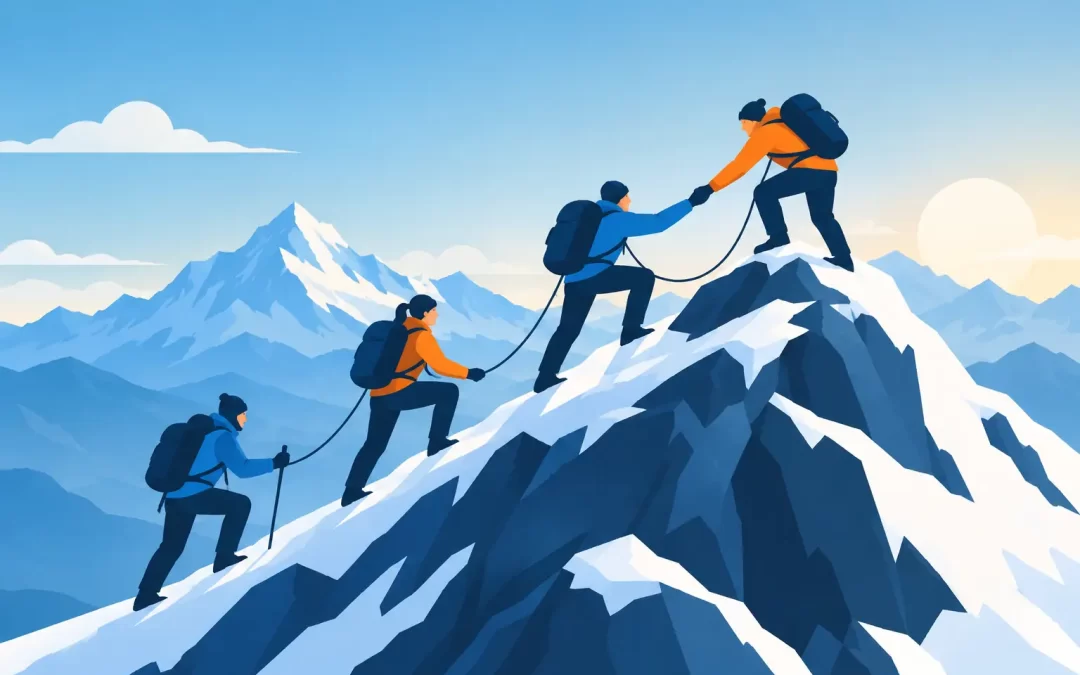
At high altitude, a team does not succeed because everyone is talented. It succeeds because people communicate clearly, prepare honestly, and make sound decisions when fatigue narrows perspective. That is why Everest teamwork lessons resonate far beyond the mountain. For leaders responsible for ambitious goals, change initiatives, sales performance, or complex events, the mountain offers a stark reminder: individual strength matters, but coordinated action is what gets people safely to the top of the world.
Gary Guller’s journey as the first person with one arm to summit Mount Everest was never a story of solo triumph. It was a test of preparation, trust, humility, and the willingness to depend on others while being dependable in return. The same principles shape high-performing organizations, especially when pressure is high and the margin for error is small.
1. Shared purpose must become personal
A summit goal can be printed on every expedition plan, yet it only becomes powerful when each person understands what it demands of them. Climbers may have different roles, experiences, and motivations, but they must align around the same outcome: move as a team, protect one another, and make decisions that serve the mission rather than individual ego.
Corporate teams face the same challenge. A strategic priority such as growth, customer retention, or a successful transformation can sound clear in a leadership presentation. But clarity at the top is not the same as commitment throughout the organization. People need to know how their work connects to the outcome, what choices they own, and where collaboration is essential.
The practical question for leaders is not simply, “Have we communicated the goal?” It is, “Can every person explain how their role helps the team reach it?” When the answer is yes, execution becomes more focused and accountability becomes more natural.
2. Trust is built before the difficult moment
Trust on Everest cannot be improvised at 26,000 feet. By the time a team reaches the most demanding part of a climb, members need confidence in one another’s preparation, judgment, and willingness to speak up. They have already watched each other respond to changing weather, difficult terrain, setbacks, and exhaustion.
In business, teams often wait for a major deadline, a market disruption, or a performance problem to discover whether trust exists. That is late. Trust is built in smaller moments: whether commitments are kept, whether leaders share difficult information early, whether people receive credit, and whether disagreement can happen without punishment.
This does not mean every decision requires consensus. Strong teams can move quickly because they trust the process and the people involved. But speed without trust creates silence, second-guessing, and expensive rework. Trust gives a team the confidence to challenge an idea before it becomes a larger problem.
3. Clear communication beats impressive communication
At altitude, vague language can carry real consequences. A message has to be direct enough to be understood through wind, fatigue, oxygen deprivation, and stress. The goal is not to sound polished. The goal is to ensure the right person hears the right information in time to act on it.
That standard is useful in every high-stakes organization. Leaders can unintentionally bury a critical decision inside a long update, use language that leaves room for interpretation, or assume that a message sent was a message understood. Teams then lose time clarifying priorities that should have been unmistakable.
Make the message actionable
When the stakes rise, communication should answer three questions: What has changed? What does it mean? What happens next? A team does not need more noise. It needs the information that enables good judgment.
There is a trade-off, of course. Over-simplifying a complex issue can create false confidence. The answer is not to hide nuance. It is to separate essential direction from supporting detail, then make space for questions. People perform better when they know both the immediate action and the reasoning behind it.
4. The strongest teammate is not always the loudest one
A successful expedition requires different strengths. Someone may be exceptional at route finding, another at logistics, another at maintaining morale when the conditions turn difficult. Leadership is not about proving who is toughest. It is about seeing the capability in the group and putting it to work.
This is one of the most relevant Everest teamwork lessons for organizations building inclusive cultures. Teams lose valuable insight when they define competence too narrowly or reward only the most visible contributors. A person with a different lived experience may identify a risk others have missed, ask a question that improves the plan, or bring resilience shaped by challenges their colleagues have not faced.
Inclusion is not a ceremonial value added after the strategy is set. It is a performance advantage. It expands the range of ideas, perspectives, and solutions available when a team encounters uncertainty. The best leaders create an environment where people do not have to fight to be heard before they can help the team succeed.
5. Accountability means speaking up early
On a mountain, ignoring a small issue can turn it into a dangerous one. A piece of equipment that does not fit correctly, a teammate who is struggling, a weather pattern that looks unstable, or a route that is taking too long all deserve attention before they become emergencies.
High-performing teams apply the same discipline at work. They do not confuse optimism with avoidance. They report bad news early, surface risks without drama, and treat course correction as a sign of professionalism rather than failure.
Leaders set the tone here. If people believe they will be blamed for raising a concern, they will wait. If they see leaders respond with curiosity, urgency, and fairness, they will speak while there is still time to act. Accountability is not about finding someone to fault. It is about refusing to let preventable problems grow in silence.
6. Adapt the plan without abandoning the mission
No Everest expedition unfolds exactly as imagined. Weather shifts. Conditions change. A team member may need more time, or a route may no longer be the right choice. The summit remains the aspiration, but the path has to respond to reality.
Organizations often struggle with this balance. Some teams cling to a plan long after the facts have changed because they fear appearing indecisive. Others change direction so frequently that employees lose confidence in the destination. Both approaches drain momentum.
Resilient leadership separates the mission from the method. The objective may remain firm, while the tactics, sequence, timing, or resources change. That distinction gives people permission to adapt intelligently without feeling that every adjustment means the strategy has failed.
7. Success includes how the team comes back
A summit is only halfway. Climbers still need to descend safely, care for one another, and return with the lessons that will make the next challenge wiser. The same is true after a product launch, major event, sales push, or difficult organizational change.
Too many teams rush immediately to the next target. They celebrate briefly, if at all, then move on without examining what created the result or what nearly derailed it. That wastes hard-earned experience and leaves people depleted.
After a major effort, ask what the team should repeat, what it should change, and what support people need now. Recognize the people whose contributions may not have been visible from the outside. A culture that honors recovery and reflection is not lowering its standards. It is building the capacity to perform again.
Bringing Everest teamwork lessons into the room
The value of an Everest story is not the altitude or the headline. It is the moment an audience recognizes its own mountain: a demanding target, a fractured team, a difficult conversation, or a personal limit that has begun to feel permanent. The most meaningful keynote experiences turn that recognition into a practical commitment to communicate better, lead with greater courage, and help others rise.
Your team may never face a crevasse or a summit push in freezing wind. But it will face moments when pressure tests its preparation, trust, and belief in what is possible together. Build those habits before the climb gets steep, and when the next challenge appears, your people will be ready to go beyond their limit – together.