
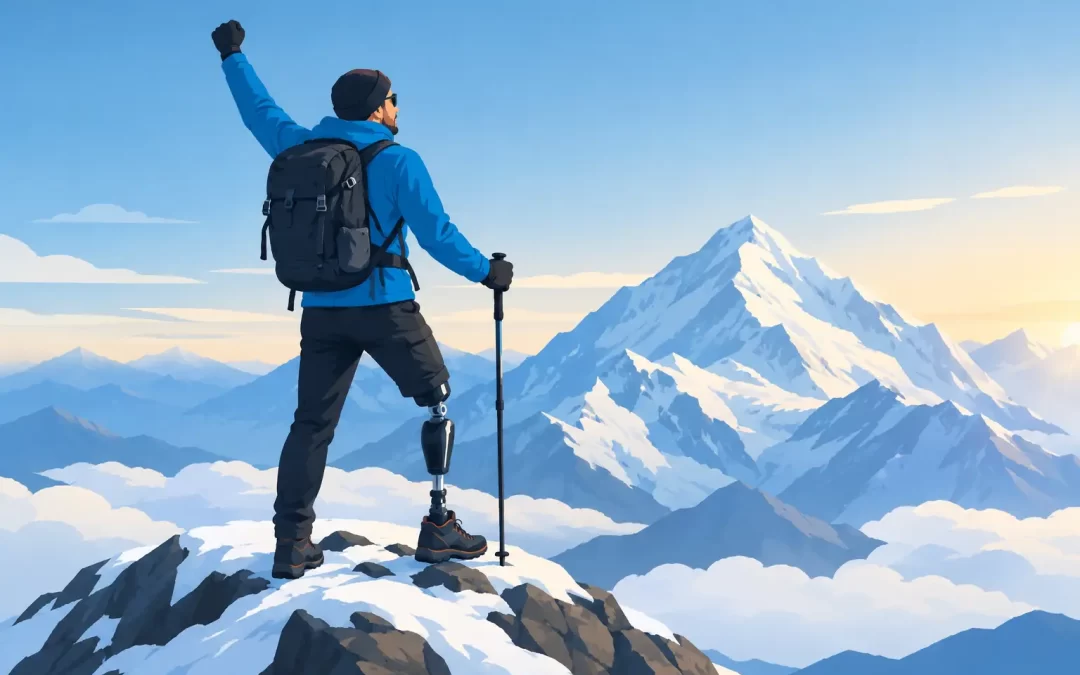
A search for gary guller disabled everest summit often begins with a question about physical limitation. The more meaningful story is about what happens when a person, and the team around them, refuse to let a perceived limitation define the size of the goal. Gary Guller became the first person with one arm to reach the summit of Mount Everest. That achievement is extraordinary. But the lessons behind it are not reserved for climbers or extreme athletes.
At 29,029 feet, there is no room for empty motivation. Preparation matters. Communication matters. Trust matters. Decisions carry consequences, and every member of the team has a role in reaching the objective safely. That is why the Everest story resonates so deeply with leaders, sales organizations, and teams working under pressure: the mountain reveals principles that also determine performance in business.
Gary Guller’s Disabled Everest Summit Achievement
Gary lost his left arm below the elbow after a childhood electrical accident. Years later, he stood on the highest point on Earth, having climbed through some of the planet’s most demanding terrain with one arm. His Everest summit was not a stunt designed to prove that adversity does not exist. Adversity was present at every stage of the climb.
One-handed climbing requires real adaptation. Tasks that other climbers may perform automatically – securing gear, managing ropes, adjusting equipment, moving efficiently in extreme cold – require different methods, more planning, and disciplined execution. On Everest, small inefficiencies can compound. Fatigue, weather, altitude, exposure, and limited oxygen do not negotiate.
That reality makes the accomplishment more powerful, not less. Gary did not reach the summit by pretending the challenge was equal for everyone. He reached it by recognizing the challenge clearly, preparing relentlessly, accepting support, and finding a way forward one deliberate step at a time.
For organizations, this distinction matters. Resilience is not denial. It is the ability to face facts without surrendering possibility. A team dealing with a difficult market, a major transformation, a missed target, or internal uncertainty does not benefit from false optimism. It benefits from people who can say, “This is hard. We are still capable. Here is how we move.”
The Mountain Is Never a Solo Achievement
The image of a climber standing alone at the summit is compelling, but it can be misleading. Everest is a team endeavor. Behind every successful ascent are partners, guides, Sherpas, planners, family members, medical support, weather intelligence, logistics, and a group of people committed to sound decisions.
Gary’s story challenges the familiar corporate myth of the lone hero. Exceptional individual performance can inspire a team, but sustainable success is built through interdependence. The strongest leaders do not confuse asking for help with weakness. They create an environment where people can contribute their expertise, speak up about risk, and take shared ownership of the mission.
This is especially relevant for leaders managing high-performing teams. When pressure rises, communication often narrows. People protect their own work, assumptions go unchallenged, and concerns arrive too late. On a mountain, that can be dangerous. In business, it can result in lost customers, flawed execution, disengagement, or preventable mistakes.
The alternative is a culture of direct communication. Team members need permission to surface what they see, even when the message is inconvenient. Leaders need the confidence to listen without defensiveness. A summit is not reached because everyone agrees all the time. It is reached because the team remains aligned around a shared objective and honest about what the conditions require.
Inclusion Is a Performance Advantage
Gary’s Everest achievement also carries a message that reaches beyond inspiration: inclusion changes what a team believes is possible. When organizations make room for different experiences, abilities, viewpoints, and ways of solving problems, they expand their capacity to perform.
That does not mean lowering standards. Everest certainly does not lower them. It means removing unnecessary barriers while holding fast to the standards that protect excellence. The question becomes less about whether every person approaches a challenge in the same way and more about whether the team is equipped to let capable people contribute at their highest level.
Gary later led a record-setting expedition of people with disabilities to Everest Base Camp. That expedition made the same point on a larger scale. Capability is often underestimated when others focus first on what they assume cannot be done. Progress begins when a group replaces assumptions with preparation, resourcefulness, and accountability.
For HR and learning leaders, this has practical implications. Inclusion is not merely a statement on a wall or an annual initiative. It shows up in the way teams assign meaningful work, develop talent, design meetings, share information, and respond when someone needs a different path to deliver an excellent result. The business case is straightforward: people who feel seen, trusted, and challenged are more likely to bring their full capacity to the work.
What Everest Teaches About High-Pressure Execution
The summit is memorable, but the expedition is won long before summit day. Climbers prepare for years, train in difficult conditions, build endurance, study systems, test equipment, and learn how their bodies and minds respond under stress. When the decisive moment comes, they rely on habits established well before the crisis.
That is a useful lens for any organization facing aggressive goals. Teams do not suddenly become focused, collaborative, or resilient when the stakes rise. They reveal the practices they have already built. If priorities are unclear in normal conditions, they will be unclear during a critical launch. If people avoid difficult conversations when the calendar is open, they will not suddenly communicate well under a deadline.
High-performance execution depends on a few disciplines that are simple to name and difficult to maintain: clarify the objective, establish roles, prepare for changing conditions, monitor reality, and adjust without losing the mission. These disciplines are not glamorous, but they are what keep a team moving when plans change.
There is also a crucial trade-off that strong leaders understand. On Everest, turning around can be a sign of wisdom, not failure. Weather may shift. A climber’s condition may deteriorate. The team may determine that the risk has become unacceptable. Summit fever – the refusal to abandon a goal despite clear warning signs – can lead to disastrous decisions.
Business teams face their own version of summit fever. A project may no longer serve the strategy. A launch may need to be delayed. A sales pursuit may consume resources without a viable path forward. Persistence matters, but persistence without judgment can become costly. The best leaders know when to press on and when to reassess. They protect the long-term mission rather than sacrificing it for a short-term symbol of success.
Turning a Personal Story Into Shared Possibility
The lasting impact of Gary Guller’s Everest summit is not simply that one person reached an extraordinary destination. It is that the accomplishment invites every audience member to examine the limits they have accepted without question.
For an executive, that limit may be a strategic assumption about what the organization can achieve. For a sales team, it may be a belief that a difficult territory cannot be transformed. For an employee navigating change, it may be the fear that a setback has permanently narrowed their future. The details differ, but the human response is familiar: people often decide where the ceiling is before they have tested their capacity, strengthened their team, or asked for the support they need.
A powerful keynote does more than create a moment of applause. It gives people a language for the challenges waiting when they return to work. Gary’s expedition stories, images, and hard-earned perspective make leadership, resilience, teamwork, and inclusion tangible. They move the conversation from abstract values to a practical question: What would this team attempt if it chose to go beyond its assumed limit?
The answer will not look like Everest for most organizations. It may look like a better conversation, a more courageous decision, a stronger partnership, or a goal that once felt out of reach. The next step is rarely a leap to the top of the world. It is a clear, committed step taken together.