
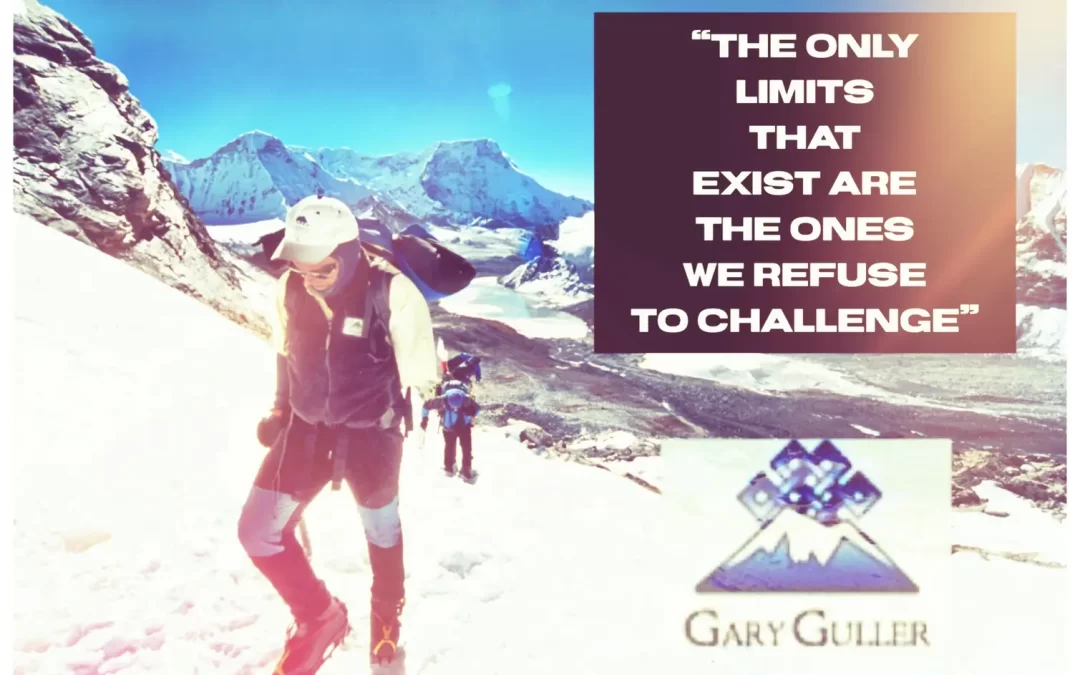
At 17,598 feet, Everest Base Camp does not reward titles, intentions, or individual bravado. It rewards preparation, clear communication, and a team’s willingness to adjust when the plan meets reality. This disability expedition case study examines what happened when Gary Guller led a record-setting cross-disability expedition to Everest Base Camp – and why its lessons matter far beyond the Himalayas.
The expedition was never about proving that people with disabilities could be inspirational. That assumption is too small. It was about building an ambitious team around a demanding objective, respecting real constraints without being defined by them, and showing what becomes possible when every person’s contribution is essential.
For corporate leaders, event planners, and teams navigating pressure, change, and aggressive performance goals, that is the real story. Everest was the setting. Leadership under uncertainty was the test.
Disability Expedition Case Study: The Mission
The route to Everest Base Camp is physically punishing by design. Trekkers face thin air, cold, fatigue, steep terrain, limited recovery, and conditions that can change quickly. On a cross-disability expedition, the operational challenge becomes even more complex. Individual needs vary. Equipment, pacing, medical awareness, communication, and contingency planning must all work together.
The goal was not to erase those differences. It was to account for them honestly and build a team capable of moving forward because of its diversity, not in spite of it.
That distinction matters in business. Many organizations say they value inclusion, but inclusion can become a slogan when people are expected to succeed using systems designed without them in mind. A high-performing inclusive culture does something more demanding: it anticipates different needs, invites expertise from every level, and removes unnecessary barriers before the pressure rises.
On the mountain, ignoring a team member’s needs is not merely poor leadership. It can stop the mission. In a company, the consequences may be less visible but just as damaging: missed insight, disengagement, preventable turnover, weak decisions, and teams that look aligned until a serious challenge exposes the gaps.
Preparation Was Part of the Climb
The visible achievement was reaching Everest Base Camp. The less visible work began long before the team entered Nepal.
A serious expedition requires conditioning, route knowledge, gear planning, travel coordination, medical considerations, and a shared understanding of risk. It also requires each person to arrive knowing that the mountain will not follow the script. Weather shifts. Bodies respond differently to altitude. Timelines move. A plan is necessary, but flexibility is what keeps a plan useful.
This is where many organizations misread execution. They celebrate the launch, the sale, the transformation, or the final result, while underinvesting in the preparation that makes high performance repeatable. Teams need more than a target. They need role clarity, honest risk conversations, decision rights, resources, and permission to raise concerns early.
Preparation is not the opposite of courage. It is how courage becomes credible.
For leaders, the practical question is simple: before asking your people to perform at their best, have you made it safe and possible for them to tell you what could prevent success? The strongest teams do not wait for a crisis to discover a missing capability or an unspoken concern. They surface it while there is still time to act.
Pace Is a Leadership Decision
At altitude, pace is not about who can move the fastest for an hour. It is about whether the whole team can sustain progress across days of uncertainty. Move too quickly, and the consequences can be serious. Move too slowly without purpose, and momentum fades. The right pace comes from paying attention to conditions, people, and the objective all at once.
That challenge will feel familiar to leaders managing growth, restructuring, sales pressure, or a major strategic shift. One group may be ready to accelerate while another is still absorbing the last change. The answer is not always to slow everything down, and it is not always to push harder. It depends on the mission, the stakes, and the team’s true capacity.
A leader’s job is to see beyond the loudest voice in the room. In the mountains, that means watching for signs of fatigue, stress, or altitude illness before they become emergencies. In an organization, it means listening for operational friction, burnout, and confusion before performance slips.
Pacing also reinforces a powerful truth: equal commitment does not always look identical. Some people may carry the mission through physical endurance. Others may contribute technical knowledge, emotional steadiness, planning discipline, or the ability to keep communication clear when morale dips. The destination depends on all of it.
Trust Is Built Through Useful Communication
When conditions are demanding, vague encouragement is not enough. “We’ve got this” can lift spirits, but teams also need specific, usable communication. What has changed? What is the next decision? Who needs help? What do we know, and what are we still assessing?
On an expedition, timely communication protects people and preserves momentum. A team member must be able to say, “I need to adjust,” without fear of being treated as a burden. Leaders must be able to make difficult calls without losing the team’s trust. Everyone must understand that speaking up is an act of responsibility, not weakness.
That is the same communication standard that separates resilient business teams from brittle ones. If employees hide a risk to avoid blame, leaders receive bad news too late. If managers conceal uncertainty to appear confident, people fill the silence with assumptions. If teams do not know how decisions are made, small obstacles become political problems.
Trust is not created by a motivational poster or a polished values statement. It is created when people experience a consistent pattern: concerns are heard, facts are shared, commitments are honored, and every contributor is treated with dignity.
Gary Guller’s Everest story carries weight because it is not a theory presented from a distance. As the first person with one arm to summit Mount Everest, he understands the difference between confidence and certainty. Confidence is choosing to take the next disciplined step while recognizing that outcomes cannot be guaranteed.
The Trade-Offs of an Ambitious Goal
An expedition team must constantly balance competing priorities. Pushing toward the destination can conflict with protecting health. A carefully coordinated plan can conflict with the need to adapt. Individual preference can conflict with what the full team requires.
There is no universal formula for resolving those trade-offs. The right choice depends on information, timing, risk tolerance, and the mission itself. What matters is that the team has a decision-making framework before the most difficult moment arrives.
Businesses face similar choices every day. Should a sales organization pursue a stretch target when capacity is already strained? Should a company move quickly on a new opportunity or pause to test an assumption? Should a leader protect short-term results or invest in the capability that will matter next year?
The Everest Base Camp expedition offers a useful standard: do not confuse urgency with recklessness. Great teams can be intensely ambitious and deeply disciplined at the same time. They know when to press forward, when to pause, and when changing the approach is the only way to honor the larger objective.
What Inclusion Looks Like Under Pressure
The most meaningful outcome of a cross-disability expedition is not a photograph at a famous destination. It is the evidence that inclusion, when treated as a performance strategy rather than a public-relations gesture, makes teams stronger.
Inclusive teams see more. They plan more carefully because assumptions are challenged. They communicate more directly because needs cannot remain invisible. They become more inventive because one-size-fits-all solutions are exposed for what they are. None of this makes the work easier. It makes the work better.
For organizations, that means designing meetings, systems, leadership practices, and career paths so talent is not forced to overcome avoidable obstacles just to contribute. It means measuring inclusion by participation and influence, not just representation. It means asking whether people can bring their full capability to the mission when the pressure is highest.
A mountain does not care about a job title, a quarterly target, or an impressive résumé. It asks one question: can this team work together well enough to keep moving? The same question waits inside every major business challenge. Build the kind of team where people can speak honestly, adapt quickly, and carry one another forward – and the next summit becomes more than a possibility.