
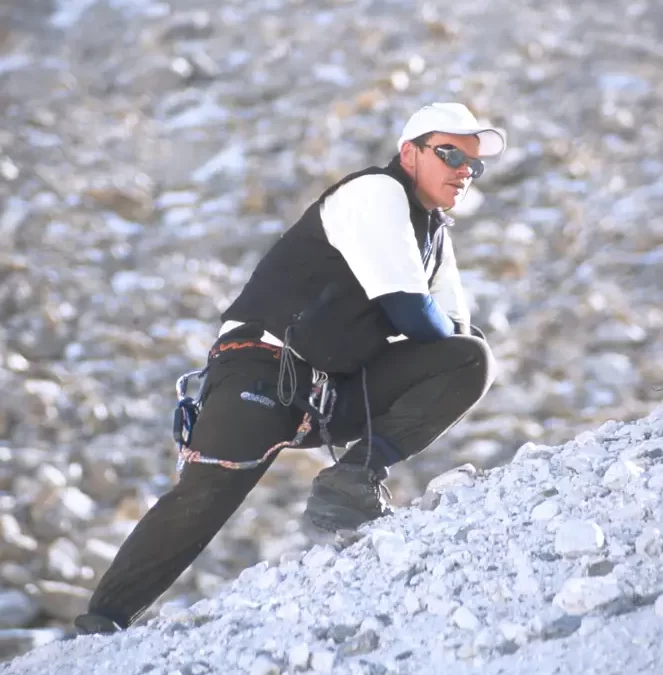
At 29,035 feet, no one succeeds alone. The phrase “one armed mt. everest summit leader” may point to an extraordinary personal record, but Gary Guller’s Everest story is ultimately about something larger: what a team can accomplish when people refuse to reduce one another to perceived limitations.
Gary became the first person with one arm to summit Mount Everest. That achievement required strength, preparation, technical skill, and a willingness to continue through fear and uncertainty. It also required guides, Sherpas, climbing partners, family support, and a deep respect for the mountain. For business audiences, that distinction matters. Great performance is never simply a solo act.
The summit is dramatic. The lessons earned on the route are what stay with people long after the applause.
A One-Armed Mt. Everest Summit Leader Redefines Possible
Everest does not negotiate. It does not care about a title, a quarterly target, or a carefully prepared plan. At extreme altitude, every decision has consequences. A small oversight can compound quickly. A change in weather can alter the entire mission. Energy, time, supplies, and trust become precious resources.
That environment gave Gary an unfiltered view of leadership. He did not climb Everest by pretending his circumstances were irrelevant. He had lost his left arm below the elbow in a childhood electrical accident. Rather than allowing that event to define the outer edge of his life, he learned to adapt, train, ask for help, and build the capabilities required for ambitious goals.
This is not a message about ignoring real obstacles. It is a message about confronting them honestly. Teams lose momentum when they spend too much time protecting appearances, hiding concerns, or waiting for perfect conditions. Progress begins when people can name the challenge, contribute what they can, and make the next smart move together.
For leaders, that is a powerful reframing. Inclusion is not a slogan or a side initiative. It is a performance advantage. When people are seen for their strengths, equipped for the work, and invited to contribute fully, organizations gain more ideas, more commitment, and more capacity under pressure.
The Climb Was Built Long Before the Summit
The summit photograph captures a moment. It does not show the years of endurance training, technical climbing, setbacks, logistical planning, or disciplined recovery that made the moment possible. That hidden work is familiar to executive teams and sales organizations pursuing demanding goals.
High performance is usually less glamorous than people expect. It is built through consistent preparation: practicing the critical skills, checking assumptions, developing contingency plans, and improving the habits that hold up when pressure rises. On Everest, shortcuts can be dangerous. In business, they can quietly erode quality, trust, and execution.
Gary’s experience invites audiences to consider a better question than, “How do we get to the top?” The stronger question is, “What must we become capable of before the decisive moment arrives?” That shift moves a team from wishful ambition to deliberate readiness.
It also changes how leaders view setbacks. A difficult stretch is not automatically evidence that the goal is wrong. Sometimes it is evidence that the team needs a new approach, a clearer role, more recovery, or a more candid conversation. Persistence matters, but intelligent persistence matters more.
Leadership Means Making the Team Stronger
Everest is often portrayed as an individual conquest. The reality is far more interdependent. Climbers depend on partners who communicate clearly, make sound judgments, and look out for one another when fatigue narrows perspective. The team must continually balance personal ambition with the safety and success of the whole group.
That tension exists in organizations every day. A leader can drive results through authority for a while. Sustained achievement, however, depends on whether people trust one another enough to surface risk, share credit, challenge weak decisions, and step forward when the plan changes.
Gary led a record-setting cross-disability expedition to Everest Base Camp, bringing together climbers with different abilities and experiences for a shared objective in one of the world’s most demanding environments. The achievement was not based on making everyone the same. It was based on recognizing different needs, different strengths, and one common commitment.
For corporate audiences, the application is immediate. Strong teams do not ask every person to contribute in identical ways. They establish a clear destination, define accountability, and create enough psychological safety for people to say what they see. They understand that help is not weakness. It is how capable people protect the mission.
Communication Gets Clear When the Stakes Rise
At altitude, unclear communication is costly. A missed instruction, an unspoken concern, or an assumption that someone else will act can put the entire team at risk. The same principle applies when organizations face transformation, market disruption, a major launch, or aggressive growth targets.
Clear communication is more than delivering information. It means creating shared understanding. What is the goal? What has changed? Who owns the next decision? What risk are we not discussing? What does success look like from each person’s position?
Those questions are simple, but they demand courage. Leaders must be willing to listen for the answer they may not want to hear. Team members must be willing to speak before a small problem becomes a major one. The strongest cultures do not eliminate tension. They make tension useful by turning it into better decisions.
Gary’s keynote experience makes these lessons tangible rather than theoretical. Expedition stories, visuals, and the emotional reality of high-stakes climbing help an audience feel the difference between merely hearing a message and owning it. That shared experience can give a conference theme, leadership initiative, or sales kickoff a language people carry back into their work.
Ambition Needs a Purpose Beyond the Peak
Reaching a summit is meaningful, but the value of an achievement expands when it helps others believe in their own capacity. That is why Gary’s story resonates across industries, roles, and career stages. It is not a tale of a superhuman person accomplishing the impossible. It is proof that limitations do not get the final word when preparation, community, and purpose meet determination.
For event planners, the right keynote must do more than energize a room for an hour. It should reinforce the outcomes the organization needs: greater ownership, stronger collaboration, resilient execution, and a culture where people see possibility in one another. An Everest story earns attention because the stakes are real. Its business impact comes from connecting that reality to the challenges people face Monday morning.
There is also a trade-off worth acknowledging. Not every goal should be pursued at any cost. On Everest, wise climbers know that turning back can be the decision that protects a future summit. In business, disciplined leaders also know when to pause, reassess, and preserve their people for the work that matters most. Courage is not reckless forward motion. It is the judgment to keep purpose ahead of ego.
The top of the world is an unforgettable place to stand. But the more enduring measure of leadership is what happens after the climb: whether people return to their teams more willing to speak up, support one another, and take the next difficult step. Together, anything is possible when the goal is clear, the preparation is real, and no one is left to climb alone.