
A sales kickoff can have a room full of talented people, a clear revenue target, and a packed agenda – yet still lack belief. A leadership retreat can have honest conversations and smart strategy, yet leave without a practical next step. That is why the choice between keynotes versus workshops deserves more thought than simply filling a time slot on an agenda.
Both formats can create meaningful change. They simply create it in different ways. A keynote gives an entire audience a shared emotional experience and a common language for what comes next. A workshop slows the room down, invites participation, and gives people time to practice. The right decision depends on the outcome you need, the size of the audience, and what happens after the event doors close.
Keynotes Versus Workshops: The Essential Difference
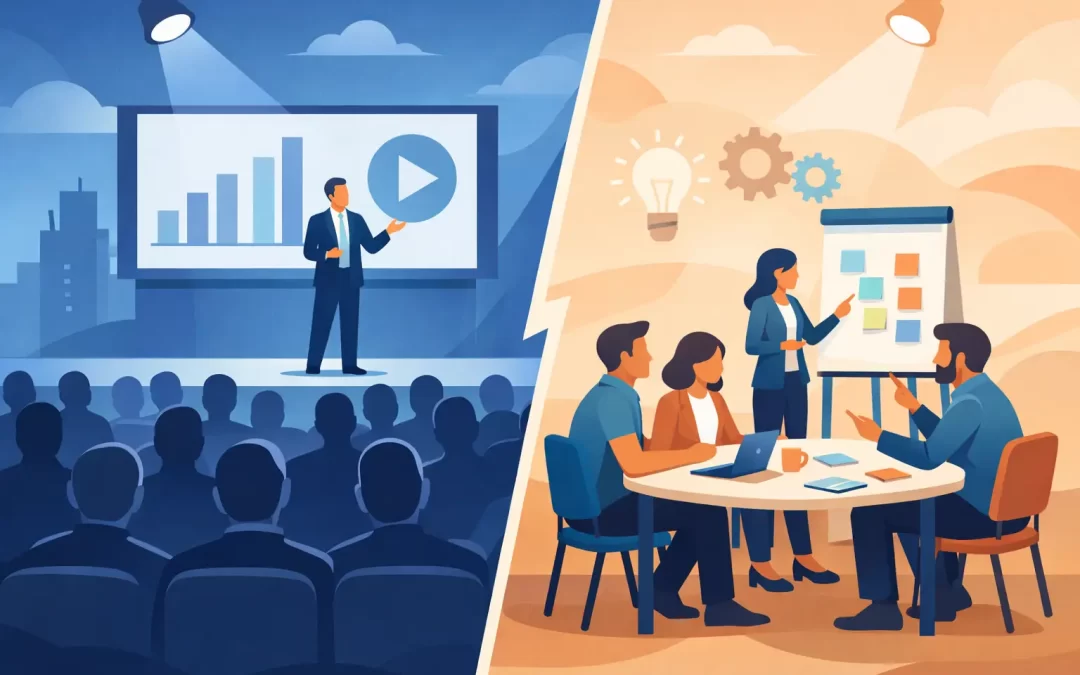
A keynote is designed to move a large audience together. It is a high-energy, high-impact presentation that frames the event, reinforces a strategic message, or shifts the emotional temperature of the room. The best keynotes are not just polished speeches. They use story, proof, visual moments, and clear takeaways to help people see a challenge differently. I specialize in opening & closing keynotes: https://garyguller.com/keynote-speaker/
A workshop is designed to involve a smaller group more directly. Participants discuss scenarios, work through decisions, test ideas, and reflect on their own habits. The goal is usually deeper skill development, more specific planning, or stronger alignment among people who must work together after the session.
Neither format is automatically better. A workshop may be the stronger choice for a leadership team defining how it will communicate through a merger. A keynote may be the stronger choice when 1,500 sales professionals need to reconnect with confidence, purpose, and the conviction that a difficult goal is still within reach.
What a Keynote Does Best
Keynotes create a moment of collective focus. At a convention, client appreciation event, shareholder gathering, or university program, that shared moment matters. People do not need to agree on every detail to be moved by the same story or challenged by the same question.
A powerful keynote can make an abstract business priority feel personal. Consider a company asking its people to perform through uncertainty. A slide with a new operating model may explain the expectation. But a speaker who has faced an unforgiving mountain, adapted when conditions changed, and depended on a team in extreme circumstances can make resilience feel real.
Gary Guller’s https://garyguller.com/keynote-speaker/ Everest experience illustrates why lived experience carries unusual weight on stage. The first person with one arm to summit Mount Everest, he does not present adversity as a slogan. He shows what preparation, communication, trust, and persistence look like when the margin for error is thin. For a broad audience, that kind of story can create the emotional lift that turns a corporate theme into a personal commitment. https://makeothersgreater.org/
What a Workshop Does Best
Workshops are built for application. Rather than asking people only to listen, they ask them to contribute. Participants can identify barriers, rehearse difficult conversations, work through team dynamics, and leave with commitments that are specific to their roles.
That makes workshops especially useful when the organization already has attention and needs capability. A manager may understand that communication matters, for example, but still struggle to give direct feedback. A workshop offers the time and structure to practice that conversation, receive input, and try again.
The trade-off is reach. Workshops typically require smaller groups, more time, and more active facilitation. They can be transformational, but they rarely create the same electric, everyone-together feeling as a keynote delivered to a full conference audience.
Start With the Outcome, Not the Format
Event planners are often asked, “Do we want a keynote or a workshop?” A more useful question is, “What must be different when our people leave?” The answer usually points to the format.
Choose a keynote when your priority is inspiration, momentum, cultural reinforcement, or a memorable opening or closing moment. It is particularly effective when leaders need to unite a diverse audience behind a direction, recognize a milestone, or restore energy after a demanding period. It can also give employees language they carry into hallways, team meetings, and customer conversations.
Choose a workshop when your priority is behavior change within a defined group. If the audience must make decisions, develop a plan, build a working agreement, or gain a repeatable skill, the additional participation is valuable. Workshops work well for executive teams, emerging leaders, high-potential groups, and departments navigating a specific operational challenge. https://garyguller.com/press-and-news/
Audience size also changes the equation. A 45-minute keynote can reach hundreds or thousands with a consistent message. A meaningful workshop with that same number of people requires breakouts, multiple facilitators, or a different design. Time is another consideration. If the agenda gives you one hour, a keynote can make that hour count. If you have a half day and a group that needs to solve something together, a workshop may earn the investment.
The Strongest Events Often Use Both
The choice does not always have to be either-or. Many of the most effective events use a keynote to establish the why, followed by workshops that build the how.
Imagine a global leadership meeting focused on execution. The opening keynote can create the shared emotional foundation: difficult goals demand honest communication, individual effort is not enough, and teams succeed by preparing for the conditions they cannot control. Later, workshop sessions can help leaders translate those principles into decision rights, meeting rhythms, accountability practices, and communication plans.
This sequence respects how people change. Inspiration without an outlet can fade quickly. Practice without emotional connection can feel procedural. When the two work together, the keynote gives people a reason to care and the workshop gives them a way to act.
There is a practical budget consideration, too. Not every event needs a full workshop program. A signature keynote can be the right centerpiece for a large gathering, while leaders continue the conversation afterward through manager guides, team discussions, or internal learning sessions. Conversely, a smaller leadership group may benefit more from a workshop than from a formal stage presentation. The format should serve the business need, not the event tradition.
Questions to Ask Before You Book
Before selecting a speaker or designing a session, get clear on the event’s real stakes. Is the organization asking people to believe in a bold new direction? Is it asking them to learn a new behavior? Are teams tired, fragmented, or facing a goal that feels beyond reach? Does leadership need one message heard consistently across the entire organization, or does a smaller group need room to wrestle with complex details?
Also consider what your audience has already experienced. If employees have spent months in training, another workshop may feel like more work unless it solves an immediate problem. If they have absorbed difficult news, a keynote built on honesty, courage, and shared possibility may be the moment that helps them look forward again.
The speaker matters as much as the format. A keynote should offer more than applause lines. It should connect a compelling story to the pressure your audience actually feels. A workshop leader should do more than present slides. They should create psychological safety, challenge assumptions, and keep the conversation tied to decisions and action.
Make the Moment Matter After the Applause
A keynote becomes more valuable when leaders reinforce its central message afterward. Refer to the story in a town hall. Ask managers to discuss one takeaway with their teams. Connect the speaker’s lessons to the goals employees are already accountable for. These simple actions tell people the experience was not just entertainment between agenda items.
Workshops need follow-through as well. Decide who owns the commitments, when progress will be reviewed, and what support participants need to apply their learning. Without that structure, even a productive session can become a folder of notes that no one revisits.
The mountain is never climbed because someone heard an inspiring message about reaching the top. It is climbed through preparation, disciplined choices, honest communication, and teammates who keep moving together when the path becomes steep. Choose the format that gives your people what they need for their next ascent – then give them a reason to believe they can make it.